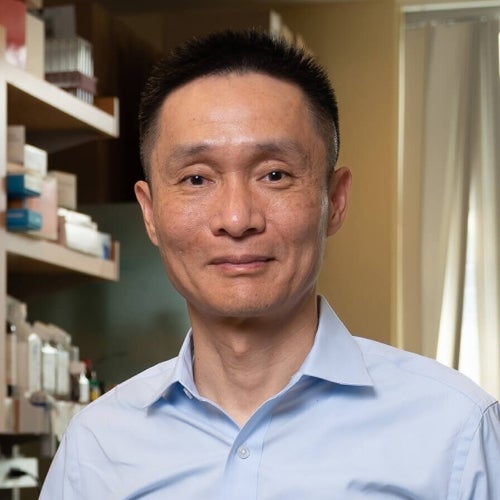
The SynthX Leader in Translational Science Award recognizes outstanding researchers who have demonstrated exceptional commitment to advancing innovative discoveries from the laboratory toward meaningful clinical and societal impact. The award honors investigators whose research exemplifies scientific excellence, interdisciplinary collaboration, and a strong potential to translate discoveries into new diagnostics, therapeutics, technologies, or approaches that improve human health. Winners are invited to give a seminar at Rice University.
Previous Winners
|
|
Fall 2025 Winner - Wilfred van der Donk, Ph.D.The fall 2025 SynthX Leader in Translational Science was Prof. Wilfred van der Donk, the Richard E. Heckert Endowed Chair in Chemistry at the University of Illinois Urbana-Champaign. He presented, "Mode of Action and Inhibition of the Enterococcal Cytolysin." Prof. van der Donk received his B.S. from Leiden University, the Netherlands, in 1989 and his Ph.D. from Rice University in 1994. He went on to do postdoctoral work at the Massachusetts Institute of Technology, and joined the faculty at Illinois in 1997. In 2008, he was appointed as an investigator of the Howard Hughes Medical Institute. His research interests are in organic chemistry and chemical biology. The van der Donk Lab research program focuses on the discovery and design of new antibiotics and natural products. These projects combine synthetic organic and protein chemistry to address problems at the interface of chemistry and biology. |
|
|
Spring 2025 Winner - Chuan He, Ph.D.The spring 2025 SynthX Leader in Translational Science was Prof. Chuan He, the John T. Wilson Distinguished Service Professor at the University of Chicago. He presented, "Mode of Action and Inhibition of the Enterococcal Cytolysin." Prof. He received his B.S. in Chemistry from the University of Science and Technology of China in 1994. He underwent his Ph.D. training with Stephen J. Lippard at the Massachusetts Institute of Technology and went on to work under Gregory L. Verdine as a Damon Runyon Postdoctoral Fellow at Harvard University. He subsequently became a faculty member in the Department of Chemistry at the University of Chicago in 2002. In 2014, he was appointed as an investigator of the Howard Hughes Medical Institute. The He Lab spans a broad range of chemical biology, nucleic acid chemistry and biology, RNA biology, and epigenetics. They discovered the first RNA demethylase and characterized functions of different RNA methylation binding proteins. They uncovered transcriptional and post-transcriptional gene expression regulation pathways mediated by dynamic RNA modifications such as N6-methyladenosine (m6A). THey developed enabling methods to map RNA and DNA modifications, and we are exploring functional importance of different RNA modifications in diverse biological systems. They also invent new genomic methods to accurately monitor transcription and chromatin state |